
Successfully recruiting an international nurse is only the first half of the workforce stabilization equation. The second half—and the true driver of long-term ROI—is how that nurse is integrated into your facility and community.
For hospital administrators and Chief Nursing Officers (CNOs), developing a specialized framework for onboarding internationally educated nurses (IENs) is non-negotiable. If you run an international hire through your standard 3-day domestic orientation, you are setting them up for clinical shock, cultural isolation, and eventual turnover.
Here are the proven best practices for clinical assimilation and cultural integration that guarantee your permanent, direct-hire nursing talent stays for the long haul.
Why Standard Hospital Onboarding Fails IENs
A domestic RN transitioning from a neighboring state already understands U.S. healthcare workflows, electronic health record (EHR) systems, and local cultural nuances. Their onboarding is primarily administrative.
Internationally Educated Nurses are highly skilled and fully credentialed (having passed the NCLEX-RN and IELTS), but they are entering a completely foreign operational environment.
Standard Domestic vs. IEN Onboarding Requirements
| Onboarding Element | Domestic RN Transfer | Internationally Educated Nurse (IEN) |
| Clinical Orientation | 3 – 5 Days | 8 – 12 Weeks (Extended Preceptorship) |
| Technology Training | Minimal (EHR Refresher) | High (EHR, Pyxis, U.S. Compliance) |
| Cultural Support | None Required | Critical (Community & Family Integration) |
| Relocation Logistics | Self-Managed | Agency-Supported (Housing, Transport) |
Phase 1: Pre-Arrival Communication & Logistics
Successful onboarding begins months before the nurse steps foot in your hospital. Anxiety is the biggest threat to an international relocation.
Best Practices:
- Virtual Meet-and-Greets: Introduce the incoming nurse to their unit manager and future preceptor via video call while they are still in their home country.
- The “Community Dossier”: Send a comprehensive digital welcome packet detailing the local area. Include information on the cost of living, public transportation, nearby grocery stores that sell international ingredients, and local schools for their children.
- Housing Readiness: Ensure temporary housing is fully furnished and stocked with basic groceries upon their arrival. After a 20-hour flight, the nurse should not have to worry about finding a blanket or a meal.
Phase 2: Clinical Assimilation & Mentorship
When onboarding internationally educated nurses, the clinical orientation phase must be extended and heavily supported.
Best Practices:
- Extended Preceptorships: Pair the IEN with a dedicated, culturally competent preceptor for a minimum of 8 to 12 weeks. Do not rush them to the floor independently just to fill a ratio gap.
- Communication Coaching: Provide specific training on U.S. patient communication standards, including bedside manner expectations, pain scale assessments, and interacting with patient families.
- Peer Mentorship Programs: If your hospital already employs international nurses, assign a “buddy” who has successfully navigated the exact same transition.
Phase 3: Cultural Integration & Family Support
A nurse will not stay at your hospital if their spouse cannot find work or their children are struggling to adapt to the local school system. Retention is a family affair.
Best Practices:
- Spousal Employment Assistance: Connect the nurse’s spouse with local staffing agencies or community career centers.
- Community Introductions: Introduce the family to local community groups, faith-based organizations, or cultural associations.
- Transportation Assistance: Navigating U.S. infrastructure can be daunting. Assist the nurse with understanding public transit or obtaining a U.S. driver’s license.
The SPARRTH Partnership: End-to-End Transition Support
Building a comprehensive international onboarding program from scratch is resource-intensive for hospital HR departments. This is why top facilities partner with SPARRTH to solve their long-term staffing shortages.
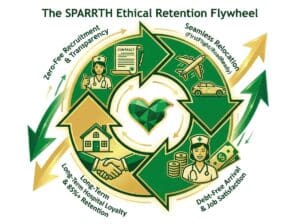
At SPARRTH, we do not just recruit elite nursing talent; we engineer their entire transition. Our direct-hire model includes proprietary transition programs designed to absorb the logistical burden of onboarding so your clinical educators can focus purely on patient care:
Secure Your Direct-Hire Pipeline
When you combine ethical recruitment with world-class onboarding, you create an unstoppable retention engine.👉 Understand the Math: Discover exactly how much your current turnover is costing you in our Executive Pillar Article: Cost of Nurse Turnover & International Nurse Retention